Change Language :

Cruise terminal
Shore power supply for cruise terminals
Cruise terminals serve passenger ships with some of the highest power requirements in the maritime sector. In addition to power supply, these terminals must also consider passenger safety, appearance, operational safety and tight schedules for port calls - often in densely built-up, urban or tourist environments.
For cruise terminals, the success of shore power depends less on electrical compliance and more on whether the connection between ship and shore can be made safely, repeatedly and without disrupting terminal operations or the passenger experience.
Shore power requirements for cruise terminals in accordance with the IEC 80005-1 (Annex C) standards

The IEEE/IEC/ISO 80005-1 standards for high voltage shore connections contain comprehensive information on the design, installation and testing of HVSC (High Voltage Shore Connection) systems. They provide general guidelines for HVSC systems as well as specific appendices for certain ship types. Appendix C is particularly relevant for cruise ships. This section contains specifications that ensure the global interoperability and safety of the systems through defined test parameters.
Some of the most important design features for cruise terminals and cruise ships are:
- The HVSC system shall be rated for a minimum of 16MVA (but 20MVA is recommended where practicable) at a nominal voltage of 11kV AC and/or 6.6kV AC. For HVSC systems with a maximum power requirement of 7.5MVA, two parallel cables with three pilot conductors each shall be used.
- Cruise ships must use four three-phase power connections, each rated at 500A, and a single-pole neutral connection rated at 250A.
- A neutral conductor continuity test with tripping function must be available.
- The short-circuit resistance is 25kA for 1s and the maximum short-circuit current is 63kA.
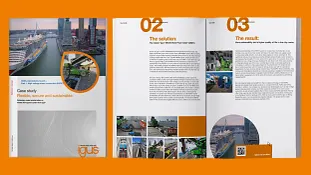
Shorepower - Case study "Cruiseterminal Rotterdam"
Rotterdam cruise terminal relies on mobile shore power system from igus
Shore power supply in harbours has become increasingly important in recent years, especially in Europe. The EU has clear climate targets and is calling for a significant reduction in CO₂ emissions from shipping in order to become climate-neutral by 2050. As a result, EU ports above a certain traffic volume are obliged to provide a shore-side power supply for ships from 2030.
Find out in our case study which challenges had to be solved during implementation and how the solution and result contribute to sustainability.
The "connection dilemma" at the cruise terminal
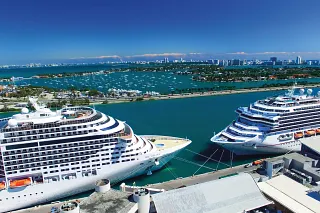
Challenge No. 1:
A lively, publicly accessible quay
Cruise terminals are not industrial sites. They include:
- Passenger boarding bridges,
- baggage and supply logistics,
- terminal vehicles and
- emergency access routes.
Fixed power sockets, pedestal interfaces and cable handling machines are permanent obstructions that
- affect the alignment of the boarding bridges,
- restrict the free operating space,
- complicate traffic management at and in the terminal.
Once installed, the fixed infrastructure determines the berths of the ships, which restricts flexibility
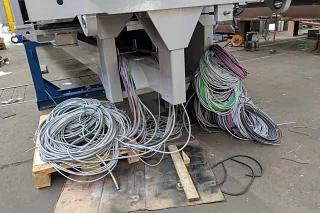
Challenge No. 2:
Cables laid on the ground as safety risks
Roller-supported and permanently installed shore power systems often lead to:
- High-voltage cables lying on the quay,
- Increased risk of abrasion, crushing and vehicle contact,
- Risk of slipping or tripping in areas with passenger traffic due to exposed cables.
Although these conditions are compliant from a technical (electrical) point of view, they are not compatible with the safety requirements for cruise terminals.
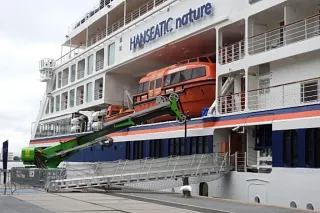
Challenge No. 3:
Large cable management vehicles
Cable management vehicles are used in an attempt to solve range problems. However, this leads to new problems.
- Limited operating range due to the length of the vehicle rollers
- Very heavy cable packages
- Dependence on slip rings
- Larger safety zones around energised 11kW devices
- Increased maintenance requirements and longer downtimes
At cruise terminals, these systems often interfere with loading operations and conflict with passenger boarding bridges.
Design objectives for the shore power supply of cruise ships
Based on the experience gained from operating a cruise terminal, effective
shore power systems must fulfil the following requirements:
- Supply of the entire berth length with a single system
- Reduction in the size and weight of the system in the quay edge area
- Elimination of slip rings and exposed, live components
- Minimisation of manual cable handling
- Removal of fixed obstacles along the quay
- All high-voltage cables are kept away from the ground
- Reduction in the number of people required for the connection process
- The system can be concealed or removed when not required
- Ensuring a clean, tidy quay suitable for passenger operations.
- Basis for repeatable connection procedures across all ship classes.
The resolution of the dilemma ... with the iMSPO
The igus Mobile Shore Power Outlet (iMSPO) was specially developed for the conditions in cruise terminals.
- "Bring the shore power to the ship, not the high-voltage equipment to the quay!"
- Route several 11kV high-voltage cables to the connection point in a protected area
- Do not lay cables on the ground or in areas with passenger traffic.
- Fully comply with the safety principles of IEC 80005-1.
- The iMSPO supports 11kV configurations with multiple cables for cruise ships
- Obstacles (such as fixed connection points for shore power) are removed.
- High-voltage cables laid exposed on the ground in publicly accessible areas are avoided
- The manual effort and manpower required for connection processes is reduced
- The repeatability of connection operations at different freeboard and inlet positions on ships is improved
- Maintains a good visual impression of the terminal in publicly viewable terminals
Cruise terminals need a shore power supply that is available and working every time the ships arrive - without "workarounds" or compromises in operation.
By decoupling the upstream electrical infrastructure from the mounting point, the iMSPO at cruise terminals enables
- flexibility in berth selection,
- improve the perception of safety among passengers and crews and
- protect long-term investments in the infrastructure.
- IEC 80005-1 guarantees safety. The IMSPO ensures that shore power supply works in the "real" operation of a cruise terminal.
- Plan your shore power supply around passengers, operations and future ship sizes - not fixed slots.
- Start early with the coordination and planning of power architecture, berth geometry and connection strategy.
Sustainable shore power supply at the Rotterdam cruise terminal
In the video: Installation of the mobile shore power connection "iMSPO" at the port of Rotterdam.
In order to reduce emissions and noise in the urban area, the port of Rotterdam relies on an innovative shore power system from igus: the iMSPO Cruise. The movable "socket" supplies cruise ships along the 230-metre-long quay wall with energy flexibly and efficiency - regardless of their mooring position.
The system is installed underground in a trench and moves precisely to the desired location using a rol e-chain. Connection by just two people takes less than 15 minutes - safe, space-saving and standard-compliant (IEC 80005-1). Up to 16MW of power is supplied from renewable sources.
The result: Less CO₂, less noise, better quality of life - a pioneering step towards sustainable harbour infrastructure.
Our solutions
igus® Mobile Shore Power Outlet
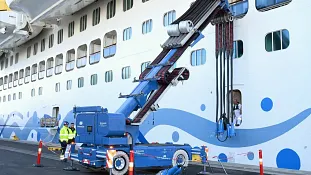
The iMSPO for cruise ships enables flexible positioning of power connections along the entire berth - exactly where they are needed. The system is fully compliant with IEC standards and can be used with any type of cable management system.
- iMSPO® for cruise terminals assembled on the quay wall
- iMSPO® for cruise terminals in a trench
More about our igus shore power solutions
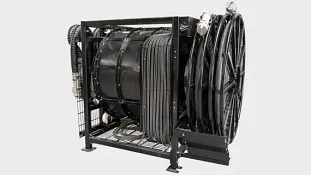
We offer you a wide range of shore power solutions suitable for many applications.
Here you will find a compact overview of our systems for shore-side power supply for ships in ports.
Services


Consulting
I look forward to answering your questions
Conlog LTD (Stocking Distributor)+972 3 9269595Write e-mail
Shipping and consultation
In person:
Monday to Friday from 7 am - 8 pm.
Saturdays from 8 am- 12 pm.
Online:
24h
WhatsApp-Service:
Montag – Freitag: 8 – 16 Uhr